Stop Running Your Clinic Like a Great Doctor. Start Running It Like a CEO.
The system we used to make that shift ourselves, and grow our clinic to multi seven figures in two years. And exactly how to install the same system in yours, even if you're not technical and marketing was never your thing.

You're great with patients. That part you've handled. But growth is a monthly surprise. Some months are busy, some are quiet, and you never really know which one's coming.
You've probably tried a few things to fix that. Maybe you hired an agency and hoped they'd figure it out. Maybe you tried to teach yourself marketing at 11pm after the kids went down.Maybe you've just leaned on word of mouth and referrals, which are wonderful right up until they go quiet for no reason at all.
And underneath it, there's this quiet, exhausting truth. You don't actually control your own growth. Someone or something else does.
I know that feeling because I lived it. And I want to show you exactly how we got out of it, because the way out is a system, and I'm going to hand you the whole thing in this guide.
In the early days, it was just us. I'm Danielle, the doctor. My husband Kyle handles the marketing and the systems.And in the beginning, we were trying to figure all of it out alone, with no playbook and no idea what we were doing.
I was working crazy hours, doing everything myself, open to close, then carrying the mental load home every night. I had real mom guilt about the bedtimes I was missing.Kyle was still in a corporate job at the time, learning Verve's marketing on the side, and for a stretch he was the primary parent for our young son.The business looked fine from the outside. From the inside, it felt like it owned us.
We said yes to anyone who'd book. No ideal patient, no niche, no plan. Just take whoever walks in and hope it adds up at the end of the month.
And the hardest part for me was this. None of this was ever taught to me. Chiropractic school teaches you how to adjust. Nobody teaches you how to find patients, how to market a clinic, or how to run a business.So I felt lost, and honestly, so did Kyle.
So we did it the slow, hard way. Piece by piece, we figured out individual tactics. A Google thing that brought a few people in. An Instagram thing that worked.A referral relationship that paid off. Little wins, scattered all over the place.
But here's the thing that actually changed everything. The breakthrough wasn't any single tactic.It was figuring out how to mesh all of them together into one cohesive system, an ecosystem where every piece feeds the others and patients come in from a dozen different directions at once instead of one.
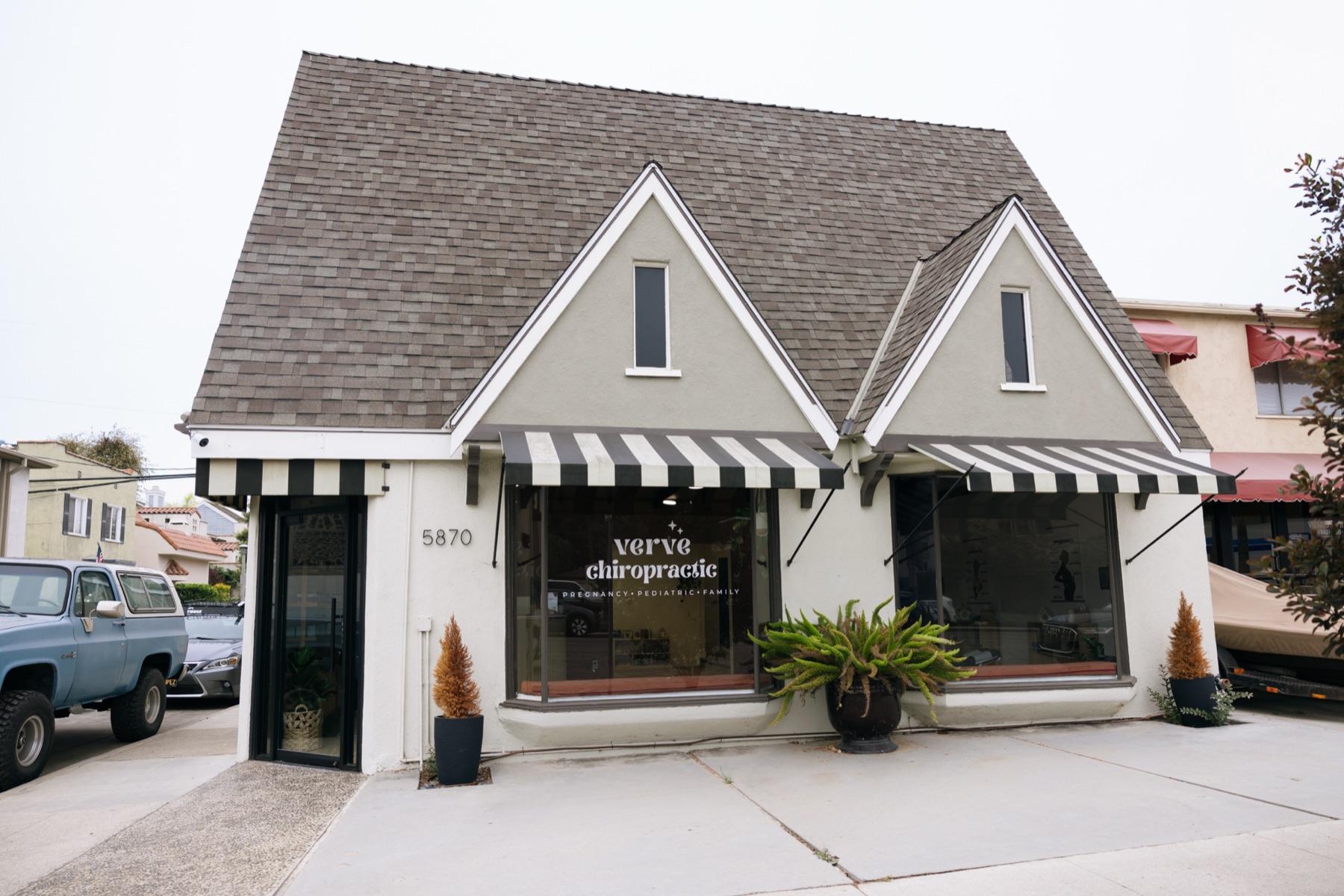
That system is what took us from those early days to multi seven figures across three clinics in two years, with more than 180 new patients a month coming from over a dozen sources.
That's the system I'm giving you in this guide. Not scattered tactics. The whole thing, already meshed together, in the order we build it.
If I just handed you the steps, they wouldn't stick, because you'd try to run them through the old way of thinking about growth.So let me reset three beliefs first. These are the shifts that made everything else work.
One. Stop renting your growth.
When you hand your marketing to an agency, you're trusting people who are juggling thirty or forty other clinics and who'll never care about your results the way you do.As they grow, quality slips and their team drifts further from your specialty. You become a box they force their template into.And you stay dependent on people who don't know your patients, your town, or your story. Nobody will ever advocate for your clinic the way you will.
Two. The problem was never one missing tactic. It's that your marketing is a pile of disconnected tactics.
A boosted post here. A random ad there. A website nobody's touched in a year. Referrals you can't predict.And nothing tying any of it together. Tactics in isolation leak, and they fail.
Growth comes from a cohesive system, where every piece reinforces the next. The ad and the Instagram page they check right afterward say the same thing.The lead hits instant follow up. The offer, the message, and the proof all line up.
Ads aren't a silver bullet you flip on to win. They're the fast engine of that system. Run them connected to everything else and they compound. Run them naked, with no clear message, no follow up, and no tracking underneath, and you're just lighting money on fire.This is the real reason so many owners tell me ads didn't work for them. The ads were usually fine.The system around them was missing.
Three. The technical gate is gone.
For years, the reason you couldn't own your marketing yourself was that it was too technical.The jargon, the ad manager, the copywriting, the tech. That gate disappeared in the last year. With AI, a clinic owner who isn't technical at all can research their ideal patient, write the copy in their own voice, build the creative, launch the campaign, and read the numbers, right from their phone.Owning your growth is finally realistic.
Want this mapped to your clinic, one on one?
On the call we look at where your patients come from now, what you've tried, and where the growth is hiding. Then we map your next six months together. If it's not a fit, we'll tell you straight and you keep the plan.
Book my strategy callThe System, In The Order We Build It
There are two stages, and they run together, not one after a long wait. First you set your foundation, which with AI takes days, not months. Then you turn on your channels in the order that gets you fast wins and builds trust, which is ads, then social, then SEO.You're not delaying ads. You're making sure that the moment your first ad runs, it plugs into a system that's ready to catch and convert.
Step 1. Choose the right patient
Most clinics market to "families" or "everyone in pain," and then wonder why nothing lands. You have to pick one specific person.
Here's how I decide who that is. Do they actually have the condition you're great at treating. Is there a trigger event making them act right now, like a new baby, a diagnosis, or a flare up.Do they see care as an investment, not a cost. Can they realistically afford your care plan.And do they have support at home so they actually follow through.
Two more filters I always add. Pick people with strong referral potential, because family units and active adults tend to bring their whole circle with them.We learned this at Verve in a way that completely changed how we spend our ad dollars. Early on we noticed we had a much higher chance of getting a whole family under care if we got the baby or the kids in first.The baby comes in, then an older sibling gets checked, then mom, and then, of course, dad is always last. Once we saw that pattern, we pointed our marketing and our future ad spend at the person who pulls the whole family in, and it multiplied our new patients while dropping our cost to acquire each one.
Step 2. Nail the message, one persona at a time
This is where most clinics quietly lose. They write one generic message to a huge group, and because it's built for everyone, it connects with no one.
Here's the shift. One audience is never really one person. Inside any group you serve, there are several distinct personas, and each one has a different pain, a different reason they're reaching out right now, and a different belief you have to shift before they'll book.Same clinic, same service, completely different conversations.
Let me make this real with pregnant women, because it's a clear example of a pattern that holds true for almost any audience you serve.If you just run ads to "pregnant women," you're speaking to at least four very different people.
Four moms. One clinic. Four completely different messages, four different fears, four different belief shifts, and four different ads and posts.That's persona based marketing, and it's the difference between content people scroll past and content that makes someone whisper, that's me.The audience changes from clinic to clinic. The principle doesn't.
Once you know which persona you're talking to, the message writes itself in a simple shape. Name her exact pain in her own words. Show her why it keeps happening, which usually isn't what she thinks.Speak to who she wants to become. Show her the thing that actually fixes it. Then prove it. Lead with the benefit, always, and cut the clinical jargon.
Step 3. Set your three offers and your price
Your offers and your price aren't just operations. They're marketing. They decide who shows up and whether they stay.
There's a clean way to think about this that the marketer Alex Hormozi teaches well. Every healthy clinic runs three offers.
The first is your acquisition offer. A low risk, easy yes first step, like a focused first visit or a condition specific assessment, that lets a new patient experience your care and decide if it's right for them. Its only job is to get as many of the right people through your door as possible.
The second is your care plan. This is your signature offer, the full priced plan that actually solves their problem. This is where the real value and the real revenue live.
The third is your wellness membership. A recurring monthly option that keeps people cared for after their plan ends, and gives you predictable revenue instead of restarting from zero every single month.
Here's the part that quietly makes or breaks clinics. When any one of those three is broken, the whole business declines or drifts sideways. No acquisition offer and you're always starved for new patients.No care plan and you leave the real money and the real results on the table. No membership and every month resets to zero.
And most of the time, the thing that breaks the second and third offers isn't strategy. It's money mindset.If you're uncomfortable presenting plans and packages, you never make the bigger offer, and all of that pressure lands right back on acquisition.Now you're forced to chase more and more new patients just to stay level, which is the most expensive, exhausting way to run a clinic there is.
Let me take one fear off the table, because I hear it constantly. A low risk offer doesn't devalue your brand.It removes the risk for a nervous new patient, gets them experiencing your care, and earns the trust that lets you present a full priced plan with confidence.The goal was never to make money on that first visit. It's to get as many of the right people in the door as possible, build real trust, and then offer them the plan that changes their life.
Two more things on price. The fastest way to make more money with zero extra work is to raise your prices, even by five dollars.Most owners are terrified to, and that fear is quietly costing them a fortune. Raise in small increments and nobody flinches.
And stop pre judging what people will pay. Ask yourself which is worse. Making a thousand dollar offer to a hundred dollar patient, or making a hundred dollar offer to a thousand dollar patient.Under offering to someone who was ready and able to invest in the full solution is the real tragedy. Make the full offer every time and let them decide.You're not being pushy. You're giving them the chance to actually get better.
One last practical piece. On your paid campaigns, a small deposit to book, something like sixty seven dollars, filters out the tire kickers and cuts your no shows, so the people who show up are serious.And know your numbers, which we're about to get into in a big way.
Step 4. Build the foundation that catches leads
Traffic without a foundation leaks, so this goes live alongside your ads, not weeks later. The moment leads start coming, three things need to already be running.
Instant follow up. Speed is everything here. Reaching out within the first two minutes makes someone dramatically more likely to book, and most clinics take hours or days. One of the owners I coach realized only half of her monthly leads were ever getting booked, purely because follow up was slow and manual.
Automated nurture, for the people who don't book right away, so they hear from you again and again with a reason to come in.
And tracking, so you actually know what each ad returned. If you can't see that, you'll end up killing your winners and scaling your losers on nothing but a gut feeling.
We run all of this in GoHighLevel. An instant text and email on every new lead, a multi day nurture sequence, reactivation for old patients, and real tracking.This is the piece almost everyone is missing, and it's the difference between ads that print and ads that drain.
The steps are simple. Installing them alone is the hard part.
Every week, owners bring this exact map and we build it against their clinic, in their voice, with them. If you'd rather do that than figure it out at 11pm, grab a call and we'll start with yours.
Book my strategy callStep 5. Turn on ads first
Ads are where you get fast wins and fast data, so they go first. Here's exactly how we run them.
Start on paid social, not Google. For most clinics, Meta is cheaper and faster to test than Google Ads.
Get live fast with a Facebook or Instagram lead form. It opens right inside the app, no website needed, so you can launch quickly and start learning immediately.Then, once you've got signal, upgrade to a simple landing page to raise your lead quality. Your cost per lead usually ticks up a little, but the patients are better and more of them actually start care.Add the deposit from Step 3 to filter even further.
For creative, the stuff that works isn't fancy. Short b-roll reels of you treating with text on screen, simple static image ads, and carousels. Real footage beats polished stock every time.
On targeting, go fairly broad and let your message do the qualifying. Modern Meta delivery does really well with broad audiences and mixed creative in a single ad set, so you don't need to slice yourself into a dozen tiny audiences.
Now, once you launch, your job isn't to be right. It's to validate. You're testing which formats and which messaging angles the data actually rewards. Some ads will work and some will flop, and that's the point.Read the numbers, kill what's not working without getting emotional about it, and double down on what is. We once almost killed a campaign our whole team hated, until we looked at the data and saw it had returned five times what we put in.Let the data lead, not your feelings.
And this only works if you know your numbers. This is where most owners go wrong, and it's the whole difference between scaling with confidence and flying blind.
Here are the numbers I watch on every campaign.
When you know those numbers, you can forecast your growth and scale your ad spend with real confidence, because you know exactly what another thousand dollars is going to buy you.When you don't know them, every decision is a guess.
And here's the trap almost everyone falls into. Cheap leads don't mean a thing if they're not booking. I'd take a handful of forty dollar leads who become patients over a pile of four dollar leads who never show, every single day.You also can't truly test one type of patient against another unless you're tracking what happens once they're in your office, because the lead cost only tells you half the story.
A couple of rules of thumb to anchor you. A good cost per lead is usually under fifty dollars, as long as your back end is converting.And a lead to booked appointment rate over thirty percent is solid.
Best of all, when a campaign is off, the numbers tell you exactly what to fix. If your click through rate is low, the ad itself isn't landing, so change the creative.If your cost per lead is high, change the ad, the angle, or both. If people are becoming leads but not booking, tighten your qualifying questions so you attract more serious people.And if they book but don't show up, start taking payment before the appointment. You don't guess.You read the number, and you pull the matching lever.
Step 6. Turn on social second
The second someone sees your ad, they go look you up before they book. They check your Instagram, they check your website.If your feed is empty, off message, or full of stock photos, you lose the trust that ad just earned. Social isn't for likes.It's the trust layer that closes the patients your ads found, which is exactly why it comes right after ads and says the same thing they do.
Three things make organic actually work.
Meet people where their awareness is. Not everyone scrolling is ready to book. Some don't even know they have the problem yet. Some know the problem but not that a solution exists.Some know solutions exist but have never heard of you. And some already know you and just need a reason to act now.Most clinics only ever post "book now" content, which speaks to the tiny slice already at the finish line, and then they wonder why nothing moves.Your content has to speak to all of those people.
Move them with storytelling. Facts inform, but stories move. A patient's before and after. Your own why.A real day inside your clinic. Story is how you take someone from never thought about it, to that's me, to I need to go see her.
And shift the belief that's keeping them stuck. Just like in your ads, every persona has a reason they haven't booked.It's too expensive. It won't work for me. My problem is just normal. I'll deal with it later. Good content names that belief and gently replaces it with a truer one.That's belief shifting, and it's the real job of your feed.
One more thing that quietly costs clinics patients. When your content earns a visit to your bio, don't dump people onto a plain wall of links.A link list like Linktree just points somewhere and hopes. Use a storefront style link in bio like Stan Store that actually captures the lead, houses your low risk offer, and books the appointment.The traffic your content earns should be captured, not bounced.
And you don't have to live on your phone to do this. Batch it and schedule it, and let AI carry most of the load, which is the next step.
Step 7. Turn on SEO third
Once your ads are producing and your social is catching the researchers, you build the asset that pays off for years.This one's slower to reward you, which is exactly why it goes last. You build here once you've got momentum and cash flow.
Three things move the needle.
Topical authority. Google rewards the clinic that clearly owns a topic, not the one with one thin page about everything. Pick your core conditions and go deep.One strong main page for the condition, then supporting pages around it for the causes, the treatment, the questions patients ask, and your city plus that condition.When you cover a topic thoroughly, Google starts treating you as the local authority and ranks you for far more searches than you ever targeted.
Headers. Structure every page so both a skimming patient and Google can follow it. One clear main headline that states what the page is about, then section headers using the actual words patients search.Headers aren't decoration. They're how a page tells Google what it is.
Schema. This is a bit of behind the scenes code that spells out for Google exactly what your page is.A local business, your address and hours, your services, your reviews, your FAQs. It's the difference between hoping Google understands your page and telling it plainly.It's also how you start showing up when someone asks an AI assistant to recommend a chiropractor in your city.
And never lean on SEO alone. A Google algorithm change once wiped out our new patient calls overnight because we'd gotten too dependent on one source. Diversified is protected.That's the whole reason SEO is one leg of three, not the entire plan.
Step 8. Let AI run all of it
This is what makes everything above doable for a busy, non technical clinic owner. Here's how I actually use it.
I have AI research my ideal patient and the exact language they use. I have it write the ad copy and the page copy in my voice. I use it to generate the images and carousels, which is fast and cheap.I launch and manage campaigns with it, and I can literally ask how they're performing and what to change, right from my phone.And I use it to build and schedule social content so posting stays consistent without eating my nights.
This isn't using AI like a therapist or a generic blog writer. It's a system of repeatable steps, so consistent that even a front desk team member could run it like any other process in your practice.
You now have the entire system. Every step, in the order we build it. That alone puts you ahead of almost every clinic in your town.
But I have to be straight with you, because I've watched this happen too many times. Knowing the system and installing it in your clinic, in your voice, against your market, without making the expensive mistakes, are two completely different things.
This is exactly where owners stall.
Which persona do I pick first. Is my message actually right. Why'd my ad account just get rejected. Is this cost per lead good or bad. Should I raise my price now or wait.Alone, every one of those questions can cost you weeks.
I don't want you to be one more owner who understood the system and never installed it. So I built a place where we do this together.
You're guessing alone.
Without someone who's actually done this looking at your specific clinic, you second guess every move and lose momentum. Inside, you get my eyes and Kyle's on your clinic every single week.
You hit a bump and lose weeks.
Your ad account gets rejected, your tracking won't fire, the tech confuses you. Alone, one bump costs you a month. Inside, you drop a screenshot and get unstuck the same day.
You start and never finish.
There's no accountability, and marketing quietly becomes the 11pm second job again. The weekly rhythm, the room full of owners doing the same work, and us building alongside you is what actually gets it installed and kept running.
Skip the guessing.
Bring your clinic to the call. We look at where your patients come from now, map your six months, and decide fit both ways. The thirty day fit window means the risk is on us, not you.
Book my strategy call- This is for you if you've paid an agency and still can't explain your own strategy, and you're done renting your growth.
- It's for you if your monthly new patients are a surprise and you want a system you control.
- It's for you if you have open appointment blocks, an underused associate, or a second location that needs demand.
- And it's for you if you keep buying courses and never finishing, because marketing became a second job you resent.
- Most of all, it's for you if you're ready to commit to six months of real building in exchange for never renting your growth again.
- This isn't for you if you want someone to take marketing fully off your plate forever and never understand it.
- This is do it with you, not done for you.
- It's not for you if you're not willing to put in a few focused hours a week.
- And it's not for you if six months of showing up feels like too much. The commitment is the mechanism. It's how the system actually gets built instead of almost built.
- It's not for you if you're looking for a magic button. Ads are fast, but this is a system, not a lottery ticket.
The crown jewel is our weekly mastermind call, Wednesdays at 11am Pacific.
This is where you collapse the time it takes to grow. Kyle and I run a live training on whatever you need most, whether that's ads, messaging, offers, pricing, or hiring, and then we do hot seat coaching on real clinics in the room.The single fastest way to grow is to watch someone one step ahead of you solve the exact problem you're about to hit.You're not learning in a vacuum. You're learning from a room of owners installing this same system right now, so you get to skip the mistakes that cost the rest of us months and years.
You also get office hours every Tuesday at 12:30pm Pacific, which is your same day unblock.
Bring your ad account, your funnel, your numbers, and we fix it live before it costs you a week.
You get a one on one onboarding strategy call to map your specific plan before you build anything, so you start with a clear roadmap instead of a guess.
You get our prebuilt AI skills, our templates, and the exact campaigns we run in our own clinics, so you never start from a blank page.
You get the full step by step classroom, so nothing is a mystery.
And you get a community where you can drop a question any day and get real answers, from us and from owners doing the work.
Here's what I want you to hear clearly. This isn't one of those giant programs where you pay thousands to be one of five hundred names in a chat, and you never once talk to the person whose name is on the door.Kyle and I personally coach you. You get us, our skills, our templates, our knowledge, and a room small enough that we actually know your clinic and your numbers.You're a person here, not a number.
Six months sounds long until you see the map.
The foundation goes live.
Your onboarding call maps the plan. Then we build the foundation together. Your patient picked, your message written, your follow up wired, and your first ads live before the month is out.
Read the data, turn on social.
Your ads are producing real numbers, so we read them together, kill what leaks, and double down on what works. The social engine comes on, batched and scheduled, so the trust layer catches everyone your ads reach.
Build the asset, make it routine.
SEO goes up while ads and social keep producing. By the end, the whole system runs as a weekly routine you own, and day one hundred eighty one changes nothing. It keeps running because it was always yours.
Our own clinics do over two million dollars a year, with more than 180 new patients a month coming from over a dozen sources, and we still own and run them ourselves.
Dr. Chris and Dr. Adana, Innate Family Chiropractic
Pasadena · $40,000 → $60,000 a month
Dr. Lisel, Solana Beach Wellness Collective
Solana Beach · 12 new patients in two weeks, then a confident maternity leave with her associate running the clinic
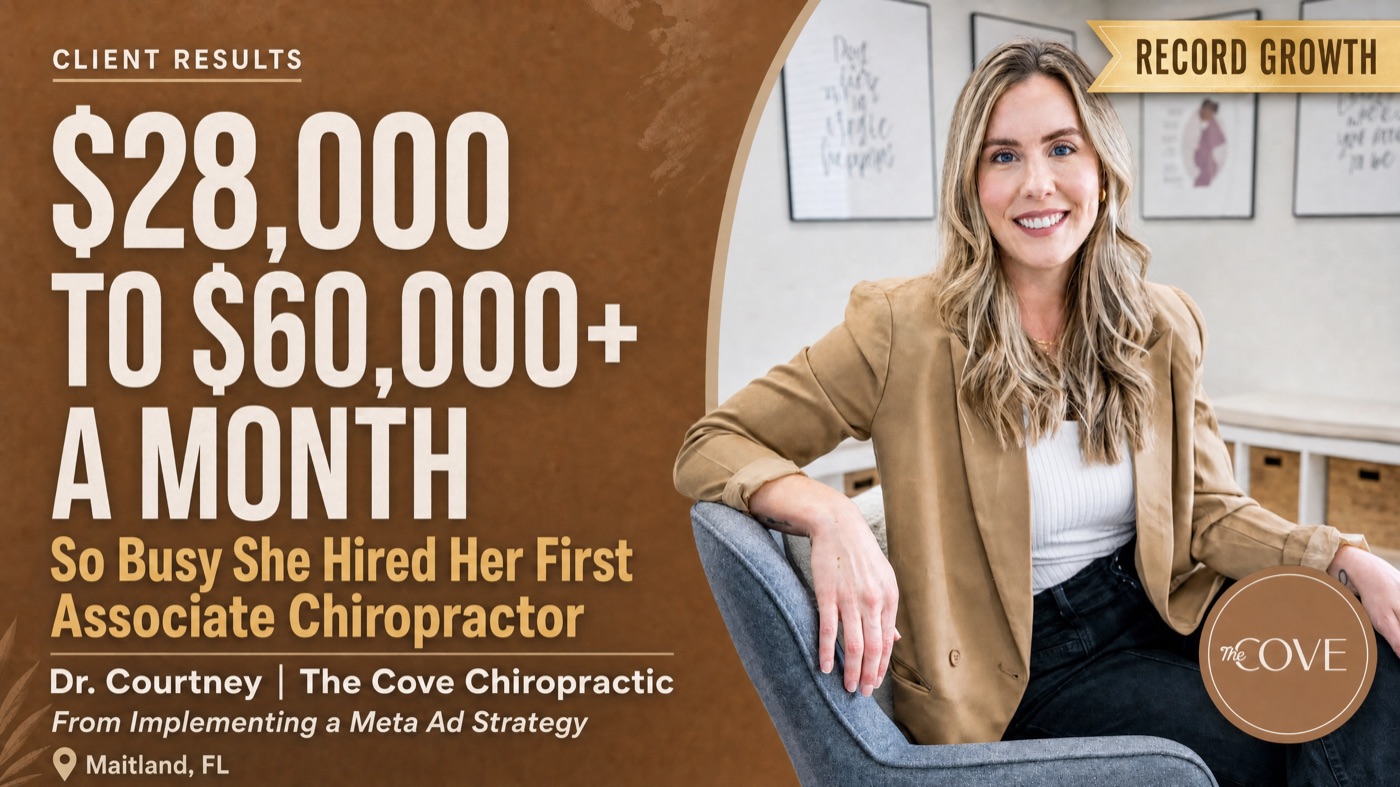
Dr. Corrine, House of Chiropractic
Huntington Beach · $18,000 → $60,000+ a month
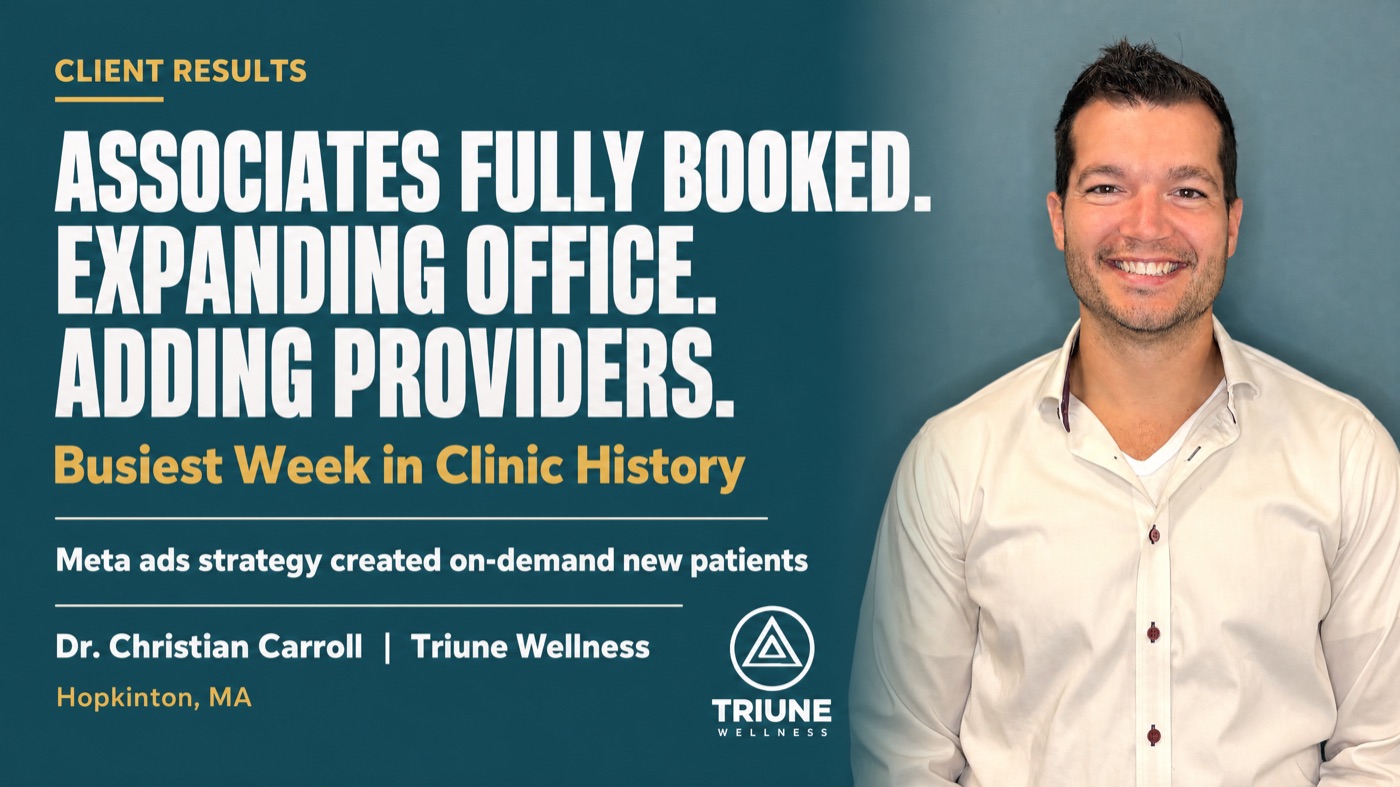
Dr. Christian Carroll, Triune Wellness
Hopkinton, MA · Busiest week in clinic history
Real clients, in their own words. Results shown are not typical and are not a guarantee. Every clinic and every owner is different.
You're not technical.
That gate is gone. The path inside is screen recorded steps, no code, plus live help whenever you're stuck.If you can run a charge in your EHR, you can do this.
You don't have time.
This isn't another course to grind through alone at midnight. We build it with you, week by week, across the six months, so it actually gets done, and the AI does the heavy lifting.
Six months feels like a long commitment.
It is one, and that's the point. Six months of building buys you a system you'll run for the rest of your career.Most owners have already spent longer than that waiting on an agency to figure it out, or telling themselves they'll get to it next quarter.The commitment isn't the risk. Staying where you are is. And it comes with a thirty day fit window.If you get inside and it's not the right room for you, you walk away in the first thirty days, no questions asked.
What does it cost?
Less than what a capable agency would charge you every month to run one channel and keep the keys. We go over the exact investment on the call, once we've both seen whether your clinic is a fit.No surprises and no pressure. The math above is the honest frame. This costs less than renting, and you keep everything you build.
You tried ads or an agency and it didn't work.
Of course it didn't. The system underneath was missing. That's the exact thing we fix, in the right order.
A capable agency runs you anywhere from one to five thousand dollars a month, plus your ad spend, and at the end of a year you own nothing. No system, no skills, no control, and a team that never cared about your clinic the way you do.You're renting your growth, and the day you stop paying, it stops.
If you pay (or would pay) an agency this much per month
Plus ad spend. On day 181 you own nothing, and the meter keeps running.
The way most clinics quietly end up doing it.
The system, the skills, and the campaigns stay with you. Nothing turns off.
For less than the price of that retainer, you install the entire system with us over six months.It runs in your house, in your voice, and on day one hundred eighty one it's still yours. Nothing turns off when the engagement ends, because you weren't renting it.You were building it.
And yes, six months is a real commitment. That's on purpose. We've watched too many owners buy a course, get busy by week three, and quietly quit.The commitment is what gets the system actually installed instead of almost installed. This is for owners who are willing to commit and learn for six months to own their growth for the rest of their career, and never depend on an agency or referral luck again.
Our promise to you
The thirty day fit window.
If you get inside and it's not the right room for you, you walk away in the first thirty days, no questions asked, and the six month commitment ends there. We only want owners who want to be building.
You risk thirty days. You stand to own your growth for the rest of your career.
That's the shift I made, from doctor to CEO. This is how you make the same one. A real CEO doesn't hand the most important lever of the business to a stranger and cross their fingers.They own it, and they lead it.
Join us
Come install this with us inside our community. We coach you personally for six months, we hand you our skills and templates, and we build it alongside you until it's running and it's yours.
The next step is one call. Here is exactly what happens on it.
We look at your clinic.
Where your patients come from now, what you've tried, and where the growth is leaking.
We map your six months.
Which persona to pick first, which offer to lead with, and which channel to turn on first for your market.
We decide fit, both ways.
If it's not right, we'll tell you straight, and you keep the plan we just built.
You leave with the diagnosis and the roadmap either way. Whether we build it together is a separate decision, and that decision goes both ways.
This is an intimate program by design. A room small enough that we know your clinic, with multiple touchpoints every week. We get to know you, your numbers, and your market, because we're building this alongside you, not waving at you from a stage.
And remember the thirty day fit window. The only thing this call can cost you is forty five minutes.
You can keep guessing, keep renting, and keep starting over every few months. Or you can install a proven system with the people who built it, and finally control your own growth. The system doesn't change. The only real variable left is whether you install it alone, or with us.
I'd love to help you install it.
Danielle